
A truck that falls flat under load usually tells on itself fast. If boost is lazy, throttle response is inconsistent, or you are chasing an overboost or underboost code, the electronic actuator for turbo diesel operation is one of the first components worth checking. On many late-model diesel platforms, that actuator is not a minor accessory. It is a control point that directly affects boost, drivability, fuel efficiency, and emissions behavior.
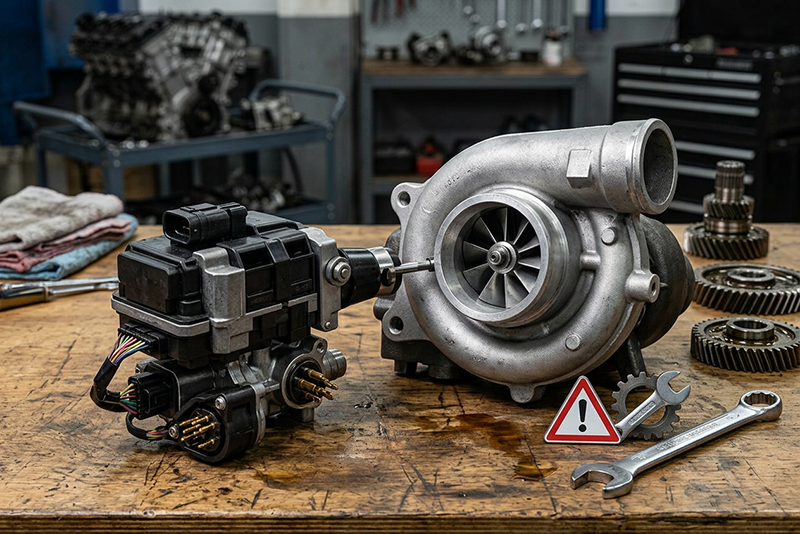
On a modern turbo diesel engine, the actuator controls turbo vane position or wastegate movement based on commands from the ECM. Instead of relying on a simple pressure canister, an electronic unit uses an electric motor and internal position feedback to move the turbo exactly where the engine needs it.
That precision matters. At low RPM, the actuator can close vanes to build boost sooner. Under heavy load, it can adjust vane position to maintain the right airflow and reduce lag. During exhaust braking on equipped applications, it can also help create the backpressure needed for stronger braking performance. If the actuator sticks, loses position, or stops communicating correctly, the turbo cannot do its job the way the engine was designed to run.
For diesel truck owners and repair shops, that means one failed component can show up as several different complaints. The truck may feel weak off the line, surge under acceleration, or drop into derate. In some cases, it will still run, but not with the consistency a working truck needs.
A failing actuator does not always look dramatic at first. Sometimes the truck still starts, idles, and drives, but power delivery is off enough that an experienced driver notices it right away. In a fleet environment, that kind of problem costs money before it becomes a hard failure.
The most common symptom is poor boost control. You may see slow spool-up, reduced power on grades, or a truck that cannot hold performance under load. Check engine lights tied to turbocharger position, vane movement, boost control, or communication faults are also common.
Another strong clue is inconsistent exhaust brake operation. If the engine brake suddenly feels weak or erratic, the actuator may not be moving the vanes as commanded. Some trucks will also show excessive smoke, especially when airflow is not matching fueling. Others may trigger limp mode to protect the engine and aftertreatment system.
It depends on the platform, of course. Cummins, Detroit, Ford Power Stroke, and Duramax applications can each set different codes and show different patterns. But the basic issue stays the same – if the actuator cannot track commanded position accurately, turbo control becomes unreliable.
Electronic turbo actuators live in a rough environment. They sit close to heat, vibration, soot, moisture, and constant duty cycles. Over time, internal electronics can fail, the motor can wear out, the gearset can bind, or the position sensor can lose accuracy.
That is only part of the story. Sometimes the actuator is blamed when the real problem is inside the turbocharger. Carbon buildup in the unison ring or vane assembly can make movement stiff enough that the actuator overworks itself trying to compensate. Wiring issues, corrosion in connectors, low voltage, and calibration problems can create the same symptoms as a bad unit.
This is where good diagnosis matters. Replacing an actuator on a turbo with sticking vanes may get the truck back on the road briefly, but it will not fix the root cause. On the other hand, replacing a full turbo when the actuator alone failed adds cost the customer may not need. A good shop separates those two failures before ordering parts.
Start with scan data. Look for commanded position versus actual position, related fault codes, and whether the actuator completes its sweep or calibration routine. If actual movement is delayed, erratic, or absent, you are narrowing in on the issue.
Next, inspect the basics. Check connectors, harness condition, voltage supply, and grounds. Diesel trucks work in hard conditions, and electrical faults are common enough that they should never be skipped. A clean-looking connector can still have terminal spread, heat damage, or moisture intrusion.
Then consider the mechanical side of the turbo. If the actuator is removed, does the vane mechanism move freely through its range? If not, the turbocharger itself may need service or replacement. That distinction matters because installing a new actuator on a binding turbo can shorten the life of the replacement immediately.
For many applications, programming or calibration is also part of the job. Some units require setup with factory-level or compatible diagnostic equipment after installation. Others arrive pre-calibrated for specific applications. This is not a detail to overlook. A high-quality part still has to be matched and installed correctly to perform the way it should.
For a working diesel truck, the right answer is usually the part that restores dependable performance without creating another downtime event next month. That is why part quality matters more than marketing language.
A properly remanufactured electronic actuator can be a strong solution when it has been tested, inspected, and built to meet the demands of the application. The value is obvious – lower cost than some new OEM options, but with quality controls that go far beyond a used takeoff part. For many owners and shops, that balance makes sense.
New OEM units can be the best fit in some cases, especially for specific fleets, warranty requirements, or highly sensitive applications. Premium replacement options also have a place when they are sourced from a supplier that understands diesel platforms and verifies compatibility.
What does not make sense is gambling on an unknown part with no real testing standard behind it. Electronic components either perform correctly or they do not. With turbo control, close is not good enough.
Fitment is first. The actuator has to match the engine platform, turbo model, and calibration requirements. Similar-looking units are not necessarily interchangeable, and getting that wrong can waste hours in the bay.
Testing is next. A replacement should come from a supplier that verifies function with appropriate equipment, not just a visual inspection. On electronic parts, bench testing, sweep verification, and position accuracy matter. If a unit has been remanufactured, the rebuild process should address wear items and confirm the actuator responds correctly across its operating range.
Warranty also tells you something about confidence in the part. A meaningful limited warranty is more than a sales line. It shows the seller expects the component to hold up in service.
Technical support matters too. Shops and truck owners do not always need someone to read a catalog line back to them. They need help confirming the right part, understanding whether programming is required, and avoiding a return cycle that keeps a truck parked longer than necessary. That is where a diesel-focused supplier earns the business.
Replacing an actuator is not a place to rush. Mounting surfaces, linkage alignment, connector condition, and calibration procedures all affect the outcome. If the turbo itself shows signs of heavy soot loading or restricted movement, address that before calling the repair complete.
Battery voltage should be stable during setup procedures. Low voltage can interrupt programming or teach-in functions and create false failure symptoms. Clear codes, run the required relearn or initialization process, and verify boost response on a road test or under controlled load.
It is also smart to look one step upstream and downstream. Airflow issues, boost leaks, exhaust restrictions, and sensor faults can influence turbo control behavior. The actuator may be the failed part, but the full system still needs to be checked if you want the truck to leave the shop right the first time.
A truck waiting on the wrong electronic part is not just an inconvenience. It is lost revenue, missed dispatches, and a repair schedule that starts backing up. That is why diesel buyers tend to come back to suppliers who can confirm inventory, understand application details, and provide parts that are ready to work.
For shops, that means less guesswork. For fleet managers, it means fewer repeat repairs. For owner-operators, it means getting back on the road with confidence that the turbo system will respond the way it should. American Diesel Parts serves that need with diesel-specific coverage, tested components, and support built around the realities of commercial repair.
If your truck is showing boost control problems, exhaust brake issues, or actuator-related fault codes, do not treat the turbo actuator like a small electrical accessory. On a modern diesel, it is a key control component. Get the diagnosis right, match the part correctly, and the repair has a much better chance of staying fixed.